Walking Pad Weight Loss: Log Steps, Not Just Meals
If your food logging is tight but the scale is stuck, your missing lever is often movement outside the gym. This guide shows how walking pads and step tracking boost NEAT, break calorie deficit plateaus, and fit into a busy professional routine.
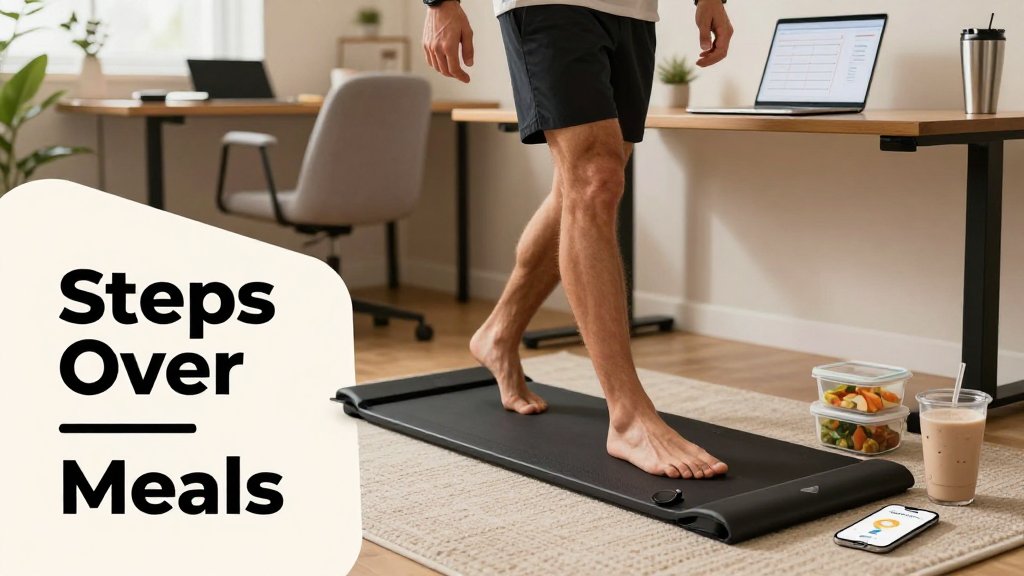
You can track every macro and still wonder why the scale will not budge. When meals stay consistent, the missing lever is often daily movement, especially for desk jobs. A walking pad can turn idle hours into effortless steps that add up fast. In this article, you will learn how steps and NEAT influence calorie burn, why small increases matter for fat loss, and how to log activity in a practical way that keeps you progressing without overcomplicating your plan.
Why steps beat workouts for busy fat loss
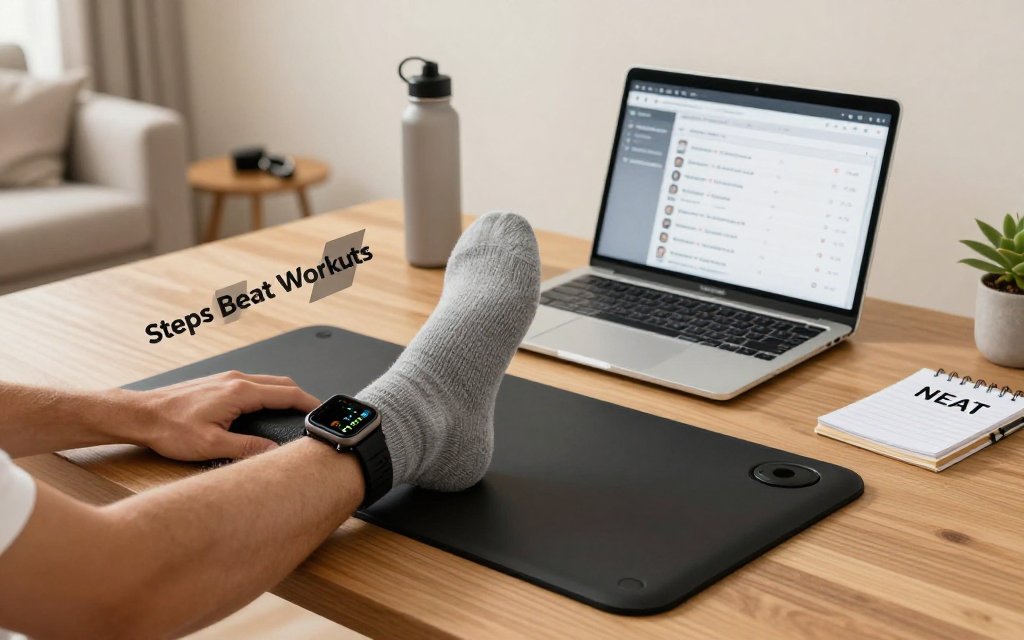
Picture the person who is doing “everything right” with food: Sunday meal prep, a turkey chili rotation, a protein shake on the way to work, and a carefully packed lunch (Greek yogurt, berries, and a measured handful of granola). They hit their calorie target, they keep dessert to one square of dark chocolate, and they even read labels. Then the scale stops moving for two or three weeks. Nothing changed, at least not on the plate. What did change is invisible: their day became chair to car to couch, with barely any walking that was not strictly necessary. That is where a walking pad often wins for busy fat loss, because it protects movement on the days life gets tight.
For people with sedentary jobs, small movement choices can swing daily calorie burn by a few hundred calories without adding a single “workout,” and the gap can be even bigger between two people who look similar on paper. Harvard Health describes NEAT (nonexercise activity thermogenesis) and notes it can vary dramatically between people of similar size, with differences up to about 2,000 calories per day in extreme cases, driven by things like sitting time versus standing and walking. Harvard NEAT overview also highlights a study where obese participants sat about 2.5 hours more per day than lean participants, while lean participants stood or walked more than two hours longer, despite similar jobs and no formal exercise requirement. (health.harvard.edu)
NEAT for weight loss, the quiet calorie burner
NEAT is the energy you burn from everything that is not sleeping, eating, or deliberate exercise. It is pacing while you are on a call, taking the long way to the printer, standing to fold laundry, walking a slow lap while your coffee brews, or using a walking pad during “camera off” meetings. Here is the quotable truth: “NEAT is the background burn that decides whether your deficit is real.” If you have ever said, “I did not change my meals, so why did I stop losing,” this is the first lever to check. Dieting and busy seasons often shrink NEAT because you subconsciously conserve energy, move less, and choose the closest possible option for everything. (health.harvard.edu)
A walking pad works when motivation fails because it lowers friction. It turns dead time into movement, which is the real superpower for busy professionals. You do not have to schedule a gym commute, you do not need a shower right after, and you do not need a perfect 45-minute block. You can walk at an easy pace while answering email, watching a training video, or scrolling through recipes for tonight’s dinner. Pair that with nutrition basics you can repeat on autopilot, like a protein-forward breakfast and lunch (if you are trying to make protein easier, these leucine threshold protein targets can help you stop guessing). The combo of steady protein plus protected steps is often what breaks a plateau without needing extreme cuts.
If your calories are steady but weight loss stalls, assume your daily movement shrank before assuming your metabolism broke. Steps are the easiest lever because they scale gently and do not spike hunger like harder workouts.
Steps vs exercise calories, the real tradeoff
The common trap is over-crediting exercise calories while ignoring what happened to the rest of the day. You do a hard workout in the morning, feel accomplished, and then you “earn the couch” by sitting more, taking fewer errands, and skipping the evening walk. The math can get annoying fast: a solid 45-minute workout might burn a meaningful chunk of calories, but losing two hours of standing and casual walking can quietly erase a big part of that. That is why steps matter for busy fat loss, they are harder to accidentally undo. A walking pad also nudges you toward movement even when you feel slightly tired, because the intensity is low and the barrier to start is basically zero.
Try this comparison for a week and keep it simple. Option A is “hero mode” once: one 45-minute workout on Tuesday, then a low-movement week because meetings took over. Option B is “boring but effective”: keep your usual workouts, if you have them, but add 3,000 to 6,000 steps spread across the day, every day, using a walking pad in 10 to 20 minute chunks. Consistency is what busy people can actually comply with. The goal is not to replace strength training or cardio if you enjoy them, it is to stop a single workout from being your only movement. If you log food carefully, logging steps (or at least watching a daily step trend) often explains plateaus faster than changing macros again.
Practical setup tip: treat your walking pad like a “movement appointment” that happens during something you already do, not as a separate fitness task. For example, walk at a conversational pace during your first inbox sweep, your after-lunch slump, and the first 15 minutes of a show at night. If you want an easy scoreboard, pick a step floor you can hit on rough days (like 7,000) and a stretch goal for smoother days (like 9,000 to 11,000). Image idea for this section: a simple two-column visual showing the same meals (for example, 1,900 calories) on two days, with one day at 3,000 steps (sedentary) and the other at 10,000 steps (walking pad day), highlighting the higher total daily burn without adding a formal workout.
How many steps for weight loss, realistically
The most useful “steps for fat loss” target is rarely a magic number like 10,000. It is a step increase you can actually keep for months, even when work is busy and motivation is low. For many people, that starts with adding about +2,000 to +4,000 steps per day above your current baseline, not jumping straight to 8,000 to 12,000 overnight. If your normal day is 4,200 steps, a realistic next target might be 6,200. If you already average 7,500, a steady bump to 9,500 can be plenty. The goal is consistency first, then ambition.
A simple step goal that does not backfire
Start with a baseline week. For 7 days, do not “try” to hit a goal. Just live your normal life and record your daily steps so you know your real average. That number becomes your starting line. From there, add steps in small doses, like a 10 minute walk after breakfast and a 10 minute walk during an afternoon call, instead of one heroic 60 minute march that you dread. Another plus is that extra steps usually raise calorie burn with less appetite spike than intense workouts, so many people find it easier to stay consistent with their food.
Steps also give you a clean “plateau lever.” If your scale trend has not moved for 2 to 3 weeks, and your food logging is honestly consistent, add steps before cutting calories again. Example: keep your usual breakfast (Greek yogurt plus berries), keep lunch steady (turkey sandwich and an apple), keep dinner portions the same (salmon, rice, and broccoli), then add 20 to 30 minutes of easy walking across the day. This is where planning filling meals helps. A high fiber lunch like dense bean salad macro math can make the added movement feel easier because you are not battling snack cravings all afternoon.
Here is a simple ramp that keeps the increase doable. The main rule is “add slowly, repeat often.” If your feet, shins, or low back get cranky, do the deload option and hold the same step goal for an extra week. This is not failure, it is how you stay in the game long enough to see results.
Under desk treadmill calories burned, practical estimates
Walking pads and under-desk treadmills are usually light intensity because you are typing, talking, or reading. The win is duration. Ninety minutes of slow walking spread across meetings can out-impact a single short workout, purely on total weekly minutes. For grounded estimates, it helps to think in METs (metabolic equivalents). The Compendium walking METs lists slow treadmill walking around 2.8 to 3.0 METs (roughly 1.2 to 2.4 mph) and moderate treadmill walking around 3.5 METs (roughly 2.5 to 2.9 mph). When you combine those METs with body weight and time, slow walking often lands around 150 to 300 calories per hour, with plenty of individual variability.
If your watch and treadmill disagree, that is normal. Wrist trackers estimate calorie burn from heart rate, motion, and your profile, while treadmills may use generic formulas that do not know your true fitness, stride mechanics, or whether you are holding the desk. Instead of chasing perfect accuracy, pick one method and stay consistent so your trend is comparable week to week. A practical approach is to track minutes and speed as your “inputs” (for example, 2.0 mph for 45 minutes), then watch how your scale trend and waist measurement respond over 2 to 4 weeks. Your body gives the best calibration.
One more reality check: if you add a lot of steps but also add “walking snacks,” progress can stall. A flavored latte (200-300 calories) plus a pastry (300-500) can erase a big chunk of a walking pad session. This is why logging both food and steps is powerful. Keep your meals boringly consistent for a couple of weeks, then adjust the easiest lever first. For many people, that lever is an extra 15 to 30 minutes of walking sprinkled through the day, not a dramatic calorie cut that makes you ravenous.
If you can add 60 to 120 minutes of slow walking spread across the workday, you often get a bigger weekly calorie impact than a couple of intense workouts. That is sustainable for most people.
Walking pad routine for sedentary job weight loss
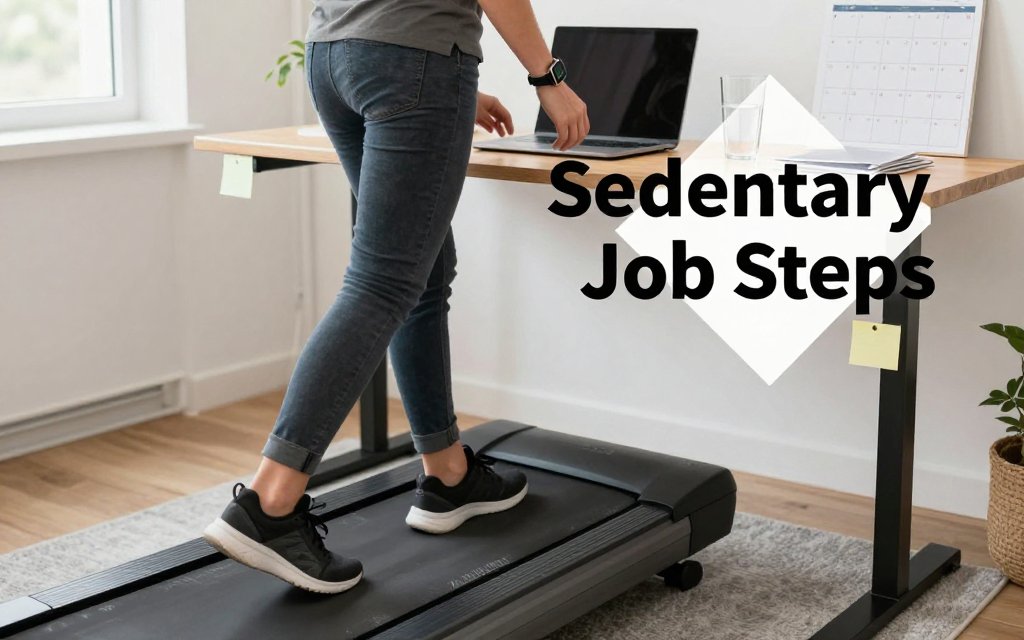
You do not need sweat, you need volume. The simplest walking pad plan is the one that hides inside your calendar: 10-minute “step snacks” between meetings, or 30 to 60 minutes of easy walking during email cleanup and training videos. This is not a hack, it is permission to keep it light and still count it. Modern U.S. physical activity guidance is clear that activity does not have to be in long blocks to matter, and shorter bouts can add up across the day (see the bouts still count Q and A). Your walking pad is a tool for stacking minutes, not for proving toughness.
Light movement wins because it is repeatable. A pace that lets you breathe normally and keep your shoulders relaxed is low friction, which means you can do it again tomorrow, and again on Thursday, and again during a stressful close-of-quarter week. It also tends to be lower injury risk than jumping straight into hard running or intense intervals, especially if you have been sitting most of the day. Finally, it stacks: three short walks sprinkled through a workday can quietly turn into 150 to 600 extra minutes per week. For fat loss, that matters because consistency makes a calorie deficit easier to maintain. It also tends to reduce the “I crushed a workout so I deserve a huge snack” rebound that can cancel progress.
The low-friction schedule that actually sticks
Aim for 30 to 120 total minutes per day, split into 2 to 4 sessions so it feels like “part of work,” not a separate workout you have to motivate yourself to do. A realistic baseline for a sedentary job looks like this: first 30 minutes of the day at 1.5 to 2.0 mph while you triage email and plan your top three tasks; 10 minutes after lunch at the same easy pace to avoid the afternoon slump; 20 minutes during an afternoon call where you are mostly listening. If you want a fourth block, add 10 to 20 minutes during end-of-day admin tasks like timesheets, training modules, or clearing your inbox. Keep the pace low enough that you can type without bouncing.
To make it stick, tie walking to habit anchors you already have. Pick two recurring meetings per week that are “camera optional” and “mostly listening,” then make walking the default for those invites. Block your calendar with a label like “Walk and respond to email” so you do not rely on willpower. A trick that helps busy professionals is to define a minimum viable day for travel or deadline days: 20 minutes total, such as two 10-minute sessions (one mid-morning, one mid-afternoon). The goal of the minimum viable day is not big calorie burn, it is protecting the identity of “I am someone who gets steps in, even when life is messy.”
Avoid the injuries that stop most beginners
Ramp up like a professional, not like an overcaffeinated Monday version of you. Increase time before speed. If you are brand new, start with 10 to 20 minutes per day for the first week, then add 5 to 10 minutes per day in week two, and keep building until you are consistently hitting 30 to 60 minutes. After that, you can extend toward 90 to 120 minutes if it feels good. A simple guardrail is to increase weekly walking volume gradually, roughly 10 to 20% per week, and back off if your body complains. Use form cues that reduce nagging aches: light, quiet steps (no stomping), tall posture, relaxed shoulders, and hands resting lightly on the desk rather than gripping it.
Most dropouts are not about motivation, they are about discomfort. Foot fatigue usually improves with real walking shoes (not slippers), a supportive insole if you need it, and a treadmill mat that reduces vibration on hard floors. Shin splints often come from doing too much too soon or from overstriding, so shorten sessions and slow down for a week, then rebuild with smaller steps and a slightly higher cadence. Lower back tightness is commonly a desk setup issue: raise your screen so you are not craning your neck, keep ribs stacked over hips, and let your arms hang softly instead of reaching forward for the keyboard. Laptop wobble is solved with stability, such as a sturdier standing desk, a monitor arm, and an external keyboard. Noise is often reduced by a thicker mat and keeping speed modest, especially if you live in an apartment.
Your best routine is the one that feels almost too easy, because easy is what you can repeat for months. If you track food and macros, treat your walking blocks as part of your daily “budget” planning: more steps can make it easier to hold a small calorie deficit without feeling like you have to slash portions. For example, if your usual afternoon snack is a 250 calorie flavored latte and a 200 calorie muffin, a 20 to 30 minute easy walk will not automatically “erase” it, but it can reduce the pressure to compensate at dinner. The win is behavioral: you are less stiff, less snacky, and more consistent. If you have pain, dizziness, or a health condition, check with a clinician before increasing your routine.
Think of a walking pad like brushing your teeth. It is not a heroic workout, it is hygiene for a sedentary day. Two hours of easy walking is boring, and that is exactly why it works.
If you want a start-tomorrow plan, keep it almost comically simple for two weeks: 30 minutes at 1.5 to 2.0 mph during your first work block, then a 10-minute walk after lunch. Once that feels automatic, add the 20-minute afternoon call walk. The moment you notice your typing getting sloppy, your shoulders creeping up, or your feet getting cranky, that is your cue to slow down, not to push through. You are building a long game habit that quietly raises your daily step total, which is exactly what most sedentary workers need. And if a day goes sideways, hit the minimum viable 20 minutes and move on, no guilt required.
Track steps and calories, then break plateaus
If the scale trend has been basically flat for 2 to 3 weeks, treat it like a signal, not a personal failure. Most plateaus are not a mysterious “metabolism broke” moment. They are usually a drift problem. Portions creep up a bit, logging gets looser, and your everyday movement quietly slides down (less pacing, fewer errands, fewer stairs). That everyday movement is NEAT (nonexercise activity thermogenesis), and it can change a lot without you noticing, which is why it is often the first lever to check. Research from the Mayo Clinic group led by James Levine highlights how NEAT can vary and meaningfully affect energy balance, even outside formal workouts, as summarized in a PubMed overview of NEAT. If you have health concerns, check with your doctor before making big activity changes.
The goal here is not perfect calorie math. The goal is a feedback loop you can run every week without overthinking it. Pick three weekly numbers to review on the same day each week: your scale trend (ideally a 7-day average), your average daily steps, and your consistency of logging (how many days you logged, and whether you logged the “easy to forget” stuff). If weight is flat and steps are down, that is your clue. If weight is flat and steps are steady, your clue is usually intake accuracy, not willpower. The win is making one change at a time so you can tell what worked.
Apple Health can make this easier because it centralizes steps, workouts, and “Active Energy” from your Apple Watch or iPhone. Pair that with walking pad sessions and you get a clear movement picture across your whole day, not just one workout. Two practical tips: first, aim to have one primary step source (usually Apple Watch), because multiple apps can double count if you are not careful. Second, treat “active calories” as a trend signal, not a food budget you automatically spend. Wearables can be decent at steps, but energy expenditure estimates can be much noisier, which is a key takeaway in a systematic review on wearable accuracy. Use the calorie estimate to compare your own weeks, not to negotiate dessert.
Here is a simple plateau playbook that works because it is boring and measurable. Keep meals the same for the next 10 to 14 days. Do not “eat cleaner” and do not start skipping meals. Add +2,000 steps per day using your walking pad, a lunchtime loop, or a few 10-minute blocks. For many people, +2,000 steps is roughly 15 to 25 minutes of easy walking and might move the needle by something like 70 to 120 calories per day, but the exact number is not the point. Reassess your 7-day scale trend after 2 weeks. If it is still flat, add another +1,000 to +2,000 steps, or tighten logging of high-variance calories like oils, bites, and drinks.
Does Apple Health step tracking calories help for fat loss?
Yes, for trends. Apple Health step tracking is most useful because step count is consistent enough to compare week to week, even if the calorie number is imperfect. Use it like a dashboard: did you average 6,200 steps last week and 8,100 this week, and did the scale trend respond? That is actionable. A simple rule that keeps people out of trouble is: do not automatically eat back exercise calories unless you have a clear performance reason (like long runs) and your weight trend is already moving the right direction. Keep intake steady, let steps do the work, and only then adjust.
Calorie deficit plateau: when should I add steps vs cut food?
Start by confirming the deficit is real. For 7 days, tighten logging accuracy before you cut anything: weigh pasta, rice, and cereal; measure oils (1 tablespoon olive oil is about 120 calories); log “tastes” while cooking; and do not forget drinks (a 16-ounce sweetened latte can be 200 to 300 calories). If logging looks solid, add +2,000 to +4,000 steps per day first, because it is a clean variable and helps protect routine. If your trend is still flat after 10 to 14 days, then consider a small cut of 100 to 200 calories per day, not a crash diet.
How do I start using a walking pad if I sit all day?
Make the first week a baseline week: track steps for 7 days without changing anything. Then add 10 to 20 minutes of slow walking during low-focus tasks (email clean-up, meetings where you mostly listen, training videos). A typing-friendly speed for many people is around 1.0 to 2.0 mph, slow enough to stay relaxed. Wear stable shoes or supportive slippers, and place the pad on a firm, non-slip surface to reduce wobble. Expect a little calf or foot soreness at first. If soreness spikes, reduce time for a few days, then build again.
If you want this to feel simple instead of stressful, put meals and movement in the same place. CalMeal helps you log food like your usual breakfast (Greek yogurt, berries, and 1 tablespoon peanut butter) and also keep an eye on step trends from your walking pad days, so a plateau becomes a quick diagnosis: intake, NEAT, or both. That clarity is what prevents random diet changes and keeps progress steady. Keep your plan boring for 2 weeks, watch the trend, and adjust one lever at a time. CalMeal is available on iOS and Android, and it is built to keep tracking straightforward when life is busy.
Ready to tighten up your results by tracking both food and consistency? Start tracking your nutrition today with CalMeal. Download it for free and take the guesswork out of calorie counting using AI-powered food recognition, so logging stays quick even on busy days. Get CalMeal on iOS or Android, then log your next meal and see how simple it can be.
Start Tracking Your Nutrition Today
Download CalMeal for free and take the guesswork out of calorie counting with AI-powered food recognition.

