Added Sugar Tracking: Find Hidden Calories Fast
Added sugar adds calories fast, often in foods that do not taste sweet. This guide shows you exactly how to spot added sugars on labels, decode percent Daily Value, avoid common “healthy” sugar traps, and track added sugar quickly without feeling like you are dieting.
You grab a “healthy” yogurt or a granola bar, log your calories, and feel confident you are on track, yet the scale will not budge. Often, the problem is not willpower or portion size. It is added sugar hiding in everyday foods, quietly pushing cravings and calorie intake higher than you think. In this guide, you will learn a fast, repeatable system to spot added sugars on labels, set a realistic daily limit, and track them in under a minute per meal, while still enjoying treats.
What added sugar really means on labels
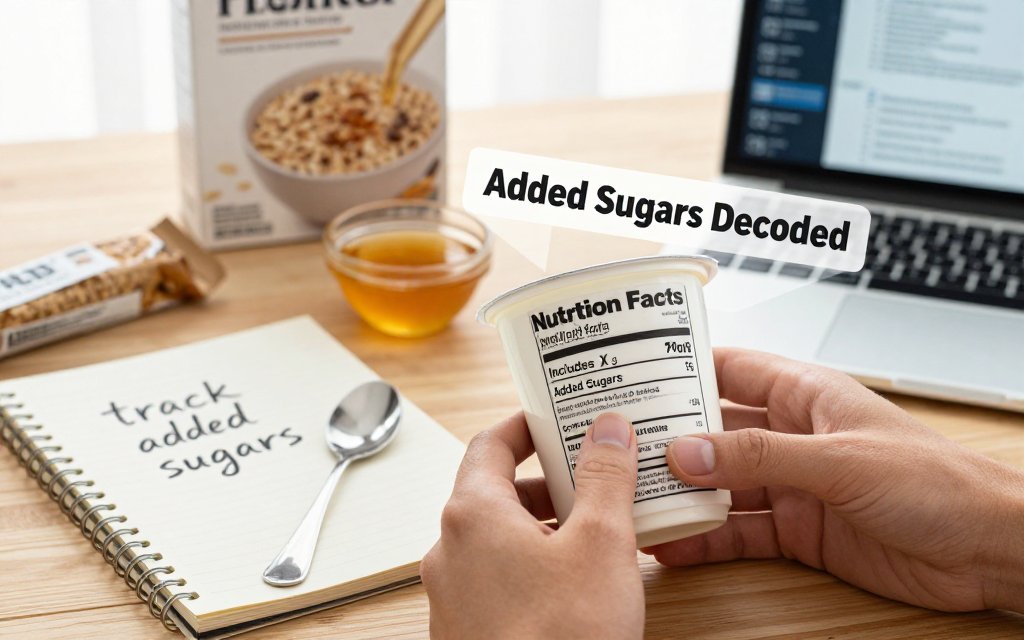
Added sugar is exactly what it sounds like: sugar that gets added to a food or drink during processing, cooking, or preparation. Think table sugar stirred into yogurt, syrup added to oatmeal packets, honey blended into granola bars, or concentrated fruit juice used to sweeten a “healthy” drink. It matters for weight loss because added sugar is easy calories with very little staying power. You can drink or snack 100 to 300 calories of added sugar fast, and still feel like you need “real food” soon after. Many people also notice that higher-sugar breakfasts make mid-morning cravings louder, especially if protein and fiber are low.
On the Nutrition Facts label, you usually find Added Sugars in the Total Carbohydrate section. Look for “Total Sugars,” then an indented line right under it that says “Includes X g Added Sugars.” That indented line is your fast number for calorie control because it separates naturally occurring sugar (like lactose in milk) from sweeteners that were added. The FDA also ties added sugars to a Daily Value, and their consumer guidance explains why the line exists, how it is shown, and how to use it to compare foods. Use FDA added sugars label details if you want to see a label example and the logic behind the “includes” wording.
Added sugar vs total sugar: the 10 second difference
Total sugar is the whole pile. It includes sugars that are naturally present plus any sugars that were added. Added sugar is just the sweet stuff that was added on purpose. Here is the 10 second label check: scan for the indented “Includes X g Added Sugars” line and treat that as the number you track for weight loss and macro goals. Why? Because naturally occurring sugar often comes bundled with protein, vitamins, or minerals (milk and fruit are good examples), while added sugar often rides along with fewer filling nutrients.
A concrete example: compare plain oatmeal to flavored packets. Plain rolled oats typically show 0 g added sugar, and total sugars are usually 0 g (or close to it). A maple-brown-sugar oatmeal packet can show the same whole grains, but the label shifts: one common packet lists 12 g total sugars and “Includes 12 g Added Sugars” in a 160 calorie serving. Yogurt is another classic: plain Greek yogurt might show several grams of total sugar from milk, but “Includes 0 g Added Sugars.” A vanilla flavored yogurt can look similar at a glance, yet the indented added sugars line jumps up, which is a big deal if you eat it daily.
If you only do one thing, find the “Includes X g Added Sugars” line. Multiply grams by 4 for calories, then divide by 4 for teaspoons. Seeing 3 to 7 teaspoons on paper changes choices fast.
Fast conversions: grams to teaspoons and calories
You do not need a calculator to feel the impact of added sugar. Two quick rules get you there: 1 gram of sugar equals 4 calories, and 4 grams of sugar is about 1 teaspoon. So 12 g added sugar is about 3 teaspoons, and it is 48 calories (12 x 4). That might not sound huge until you remember that many people aim for a daily deficit of around 200 to 400 calories. A couple of “small” sugar hits can quietly erase a chunk of that, without making you feel full in the way 48 calories of chicken, eggs, or beans might.
Now picture a before-lunch sugar stack you might not notice. Breakfast is one maple-brown-sugar instant oatmeal packet with 12 g added sugar. Mid-morning is a serving of vanilla yogurt that lists “Incl. Added Sugars 16 g” per 2/3 cup serving. Together, that is 28 g added sugar before lunch. Quick mental math: 28 g equals 112 calories (28 x 4) and about 7 teaspoons (28 divided by 4). If you are trying to keep your day in a modest calorie deficit, those 112 calories can be the difference between progress and frustration, especially if it happens most workdays.
A simple “start today” move is to keep the convenience but change what you sweeten: choose plain oatmeal and add cinnamon plus berries, or buy plain yogurt and stir in fruit and a pinch of vanilla yourself. You can still track it accurately, and you will usually end up with fewer added sugar grams for the same volume of food. When you meal prep, log the version you actually ate (dry oats vs cooked bowl, raw chicken vs cooked portion) because small logging mismatches add up over a week. CalMeal users often tighten accuracy quickly with raw vs cooked food weights, then use the added sugars line as the next “high impact” label habit.
How much added sugar is too much daily
Added sugar is one of the fastest ways to accidentally blow your calorie target, because it often shows up in foods that do not feel “sweet” at all (salad dressings, flavored yogurt, pasta sauce, even some breads). If your goal is fat loss, the win is not perfection, it is setting a daily ceiling you can actually hit, then spending that “sugar budget” on what you genuinely enjoy. If you need a quick reality check on where sugar hides, the CDC has a solid rundown on spot hidden sugars in everyday packaged foods.
Daily added sugar limit AHA: simple numbers to remember
The American Heart Association numbers are easy to remember and very practical for calorie counters: women, no more than 25 g of added sugar per day (about 6 teaspoons); men, no more than 36 g per day (about 9 teaspoons). In calorie terms, added sugar is 4 calories per gram, so 25 g is about 100 calories and 36 g is about 150 calories. If you are dieting on 1,700 to 2,200 calories per day, that AHA limit typically lands around 5 to 7 percent of daily calories, which is a tight but doable range.
Even if you train hard, keeping added sugar moderate tends to make appetite control easier. Added sugar usually arrives without much protein or fiber, so it does not “stick” the way oats, potatoes, beans, fruit, or Greek yogurt can. That matters in a calorie deficit, where hunger is the main reason people quit. A simple macro friendly way to think about it is: protein and fiber help you feel fed, added sugar helps food taste fun. You can absolutely include it, just keep it in a lane that supports your goal.
Try a realistic added sugar “budget” based on your day: if you want dessert, plan for 15 to 25 g later and keep breakfast and lunch closer to zero. If you would rather spend sugar on coffee creamer, do that, but then pick an unsweetened yogurt and a lower sugar sauce at dinner. One tip from busy clients: pair sugar spending with the other stuff you track, like hydration and electrolytes, because cravings can feel stronger when you are under fueled or under salted. CalMeal users often like combining this with sodium and potassium tracking to tighten up consistency.
How to read added sugars percent Daily Value without overthinking
If grams feel abstract, percent Daily Value (DV) makes decisions faster. The FDA sets the Daily Value for added sugars at 50 g per day (based on a 2,000 calorie diet), and their quick rule is simple: 5% DV or less is low, 20% DV or more is high. That means you can scan a label in two seconds and know if the product is “everyday friendly” or more of a treat. The FDA explains these added sugars %DV rules directly on their Nutrition Facts label guidance.
Use DV to compare similar foods fast, especially “health halo” items. Example: two granola bars might both be 170 calories, but one is 2 g added sugar (4% DV) and the other is 10 g (20% DV). Same calories, very different sugar hit. Same idea with cereals, flavored oatmeal packets, ketchup, BBQ sauce, and teriyaki sauce. Drinks are where DV saves you the most time: it is common for a single bottle to land at 50% DV or more, which can quietly crowd out your sugar budget before you even eat lunch.
If you love something sweet, keep it. Just “pay for it” with your sugar budget: choose lower added sugar options earlier, then enjoy the treat without guilt, because you already planned the calories.
Hidden sugar foods and sneaky ingredient names
A lot of added sugar comes from foods you do not think of as “sweet,” especially condiments, sauces, coffee creamers, and packaged “healthy” snacks. The fastest label trick is this: ingredients are listed in descending order by weight, so if sugar (or any sugar alias) shows up early, it is doing real work in that product. That rule is part of US labeling requirements, not a marketing preference, and you can verify it in the ingredients listed by weight regulation. If you want a quick hit list of common sneaky categories, Harvard’s hidden added sugar sources overview is a solid reference.
Hidden sugar foods you will not taste as sweet
Picture a normal lunch salad that feels “light”: greens, chicken, and a bottled balsamic vinaigrette. Many bottled dressings add a little sweetness to balance acidity. If your dressing has 3 to 6 g added sugar in a 2-tablespoon serving, that is 12 to 24 calories just from sugar (since 1 g sugar = 4 calories). That might not sound dramatic until you realize many people pour closer to 4 tablespoons. Now you are at 6 to 12 g added sugar, or 24 to 48 calories, before you count croutons or a sweetened drink. Action step: measure your dressing once, then decide if you want to keep it, cut the portion, or swap to a lower-sugar option.
Next, the sandwich trap. A turkey sandwich can look macro-friendly, but spreads and sauces stack quickly: ketchup is often around 4 g sugar per tablespoon, and many barbecue-style sauces land in the 6 to 8 g range per tablespoon. Add a “healthy” side like sushi and the sugar can keep climbing, because teriyaki and eel-style sauces commonly bring sweetness (think 4 to 8 g per tablespoon). If you do 2 tablespoons total across lunch, that is an extra 8 to 16 g added sugar, or 32 to 64 calories. Simple swap: keep sauce, but limit it to 1 tablespoon and use mustard, hot sauce, vinegar, or citrus for more flavor with less sugar.
Breakfast is another sneaky place. A flavored oatmeal packet can contain 8 to 12 g added sugar, and “light” cereals often look virtuous while still landing around 5 to 10 g sugar per serving, depending on the brand and portion. Then the add-ons hit: a vanilla plant milk can add several grams of added sugar per cup, and flavored coffee creamers can contribute 5 g added sugar per tablespoon. Two “quick” tablespoons in coffee is 10 g added sugar (40 calories) that many people do not log. One day example: 5 g from dressing + 8 g from cereal + 6 g from sauce + 10 g from creamer = 29 g added sugar without any obvious dessert.
If a sauce tastes “savory” but lists sugar or syrup in the first five ingredients, treat it like a dessert topping. Measure your serving, log it, then decide if a lower-sugar swap is worth it.
Names for added sugar ingredients and the sugar alcohols twist
Food labels rarely say “added sugar” in the ingredient list. Instead, they use specific sweeteners, and sometimes several of them, so no single one looks like the main ingredient. That is why scanning for a few common aliases is so effective. A practical habit is to circle every sugar word on the list, then check how high they appear. If two or three sweeteners show up in the top 8 ingredients, you are probably looking at a product that will be easy to overeat without noticing the sugar cost. Watch for these frequent “hidden” names (they all function like added sugar in your tracker):
Now the twist that confuses a lot of trackers: sugar alcohols (often called “polyols”) like erythritol, xylitol, and sorbitol. They are not counted as “added sugars” on the Nutrition Facts label, so a protein bar can say 0 g added sugar and still be sweet. Sugar alcohols can still contribute calories (often less than sugar, but not always zero), and some people get gas, bloating, or diarrhea when they have larger amounts, especially from “sugar-free” candy or multiple bars in a day. A simple rule that keeps you honest: track added sugar grams for your daily limit, but always log total calories and total carbs so sugar alcohol products do not turn into “free snacks.” If you have medical conditions or GI issues, check with your doctor before making big changes.
Reduce added sugar without dieting or drama
If you want faster fat loss (or easier maintenance), added sugar is a high impact place to look because it is easy to overeat without feeling full. The goal is not perfection, it is awareness plus small, repeatable swaps. Think of added sugar tracking as “find the loudest calories first,” then turn down the volume one notch at a time. You can still keep your usual meal structure (breakfast, lunch, snack, dinner), you just start steering the sweeteners into spots you actually enjoy, instead of letting them sneak into every bite. If you have any medical concerns (like diabetes, reactive hypoglycemia, or a history of disordered eating), check in with your clinician before tightening targets.
A simple added sugar tracking routine that takes 60 seconds
Here is a routine you can do while you pour coffee or microwave leftovers. First, pick a personal daily cap that feels doable, not punishing. Many busy adults start with 25 to 36 g added sugar, which lines up with the American Heart Association daily limits (25 g for women, 36 g for men), then adjust based on goals. Next, do this quick scan: 1) Identify your top two sources (usually a drink and a “healthy” snack). 2) Check the label for “Includes X g Added Sugars.” 3) Log the big hitters first in your tracker, then fill in the rest.
Use % Daily Value as your shortcut when life is hectic. On US labels, the Daily Value for added sugars is 50 g, so the math is easy: 10% DV is 5 g added sugar, 20% DV is 10 g, 40% DV is 20 g. If a snack is 18% DV, you are basically spending about 9 g of your daily budget on that one serving. The fastest workflow inside a calorie tracker like CalMeal is: scan the barcode, confirm the serving size you actually ate, then sanity check the added sugar grams and %DV so you do not accidentally log one serving when you drank the whole bottle. The FDA explains the %DV and 50 g reference on its added sugars label guide.
Now use one “swap rule” at a time so it does not feel like a diet. Good default rules are: choose unsweetened versions (plain Greek yogurt, unflavored oats, un-sweetened almond milk), then add your own flavor with berries, banana slices, cocoa powder, vanilla extract, cinnamon, or a zero added sugar fruit spread. For snacks that still hit protein and fiber targets, look for combinations like cottage cheese plus raspberries (high protein, high volume, typically 0 g added sugar), edamame with sea salt (protein plus fiber), chia pudding made with unsweetened milk and strawberries, or an apple with peanut butter (fiber plus fat for staying power). If you want packaged snacks, prioritize items with at least 10 g protein and 3 g fiber, and keep added sugar to 0 to 5 g most days.
Mini example day, same meals, less added sugar (about 18 g saved). Breakfast stays “yogurt plus fruit,” but you swap 1 cup flavored yogurt (often 12 to 16 g added sugar) for plain Greek yogurt, then add a half cup blueberries and cinnamon (0 g added sugar). Your afternoon “coffee treat” stays, but you order it with half syrup or choose an unsweetened latte and add your own cinnamon, saving another 5 to 8 g. Your evening “something sweet” becomes two squares of dark chocolate and strawberries instead of a frosted granola bar, trimming about 4 to 6 g. You still eat a snack, you just stop paying added sugar tax on all three.
How do I read added sugars percent Daily Value fast?
Treat %DV like a speedometer. Since 100% DV for added sugar is 50 g, you can convert in your head: 5% DV is about 2 to 3 g, 10% is 5 g, 20% is 10 g, 30% is 15 g. For weight loss, a practical rule is “single snack, single digit.” If a snack shows 20% DV (10 g) added sugar, log it, then decide if it is worth that much of your daily cap. Also check serving size, because a bottle with 2 servings can quietly double the %DV you think you consumed.
Do sugar alcohols count as added sugar or not?
Sugar alcohols (like erythritol, xylitol, sorbitol, and maltitol) are not counted in the “Added Sugars” line on the Nutrition Facts label, so they do not increase your added sugar grams. However, they can still matter for your plan. Some people tolerate them fine, others get bloating or urgent bathroom trips, especially with larger servings. For tracking, log the product as-is, watch your total calories, then use your own “comfort cap” if your stomach reacts (for example, limit sugar-free candy to one serving). If you track net carbs, be consistent with your app’s method and your goals.
What are the most common hidden sugar foods when trying to lose weight?
The usual “stealth sugar” winners are drinks and “healthy sounding” snacks. Watch flavored coffee creamers (5 to 10 g added sugar per splashy serving), bottled smoothies and juices (often 20 g or more per bottle), flavored yogurts, granola and protein bars (6 to 15 g), and cereals that look wholesome but still add sweeteners. Condiments sneak in too: BBQ sauce, teriyaki, ketchup, and some salad dressings can add 2 to 6 g per serving, and people pour more than one serving. The simplest fix is to log these first, then swap one at a time to low or zero added sugar versions.
Ready to start tracking your nutrition today and stop guessing what is really in your food? Download CalMeal for free and take the guesswork out of calorie counting with AI-powered food recognition. Snap or scan what you eat, log faster, and stay consistent without the hassle. Get CalMeal on iOS or Android and start your first log today.
Start Tracking Your Nutrition Today
Download CalMeal for free and take the guesswork out of calorie counting with AI-powered food recognition.

